Premium Link-Building Services
Explore premium link-building options to boost your online visibility.
Explore premium link-building options to boost your online visibility.
In the fast-paced world of digital business, time is the only non-renewable resource. Traditional marketing roadmaps, often spanning six to twelve months, are becoming obsolete before they are even fully implemented. The rapid advancement of Artificial Intelligence (AI) has rendered long-term rigidity a liability. The modern enterprise requires agility, precision, and a proof-of-concept mentality. Enter the 30-Day AI Marketing Pilot—a strategic framework championed by Miklos Roth designed to cut through the noise, validate assumptions, and build scalable infrastructure in record time.
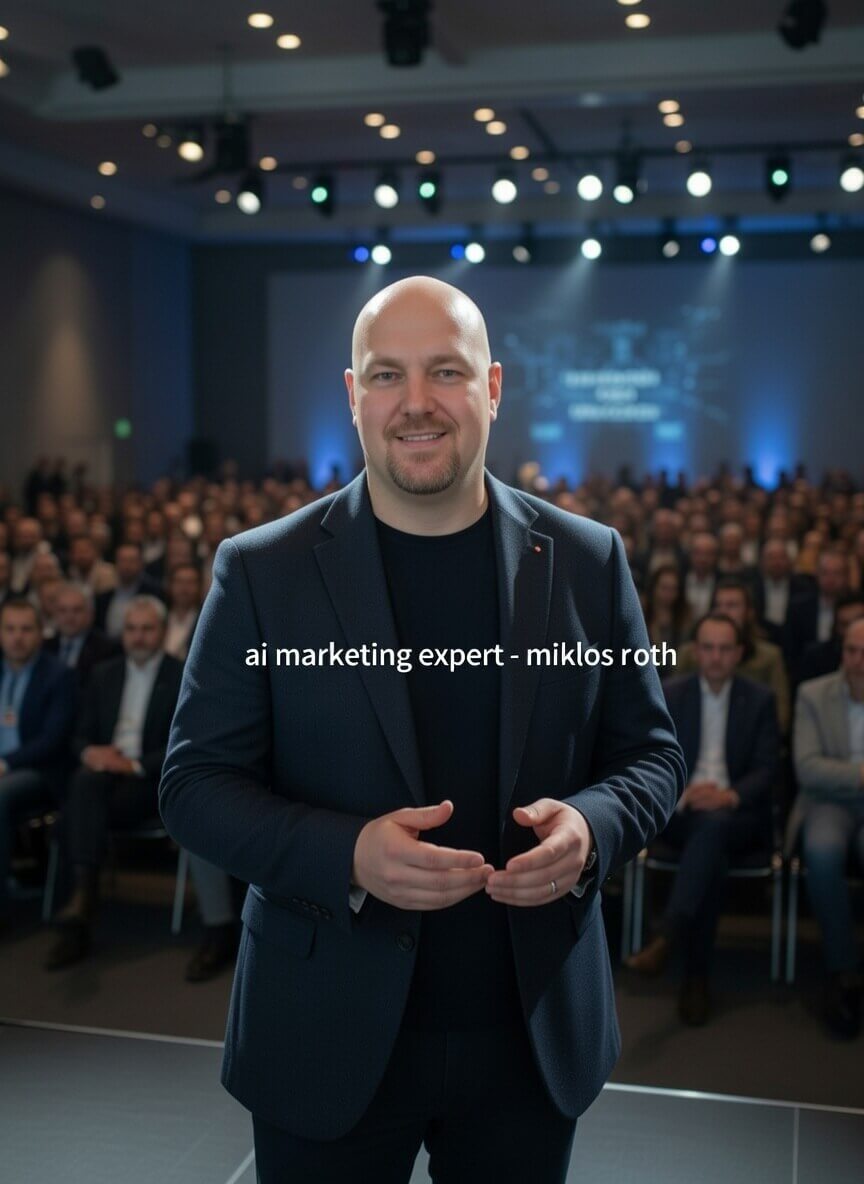
The concept of a 30-day pilot is not about rushing; it is about compression. It is about taking the intensity of a startup launch and applying it to corporate marketing structures. This article explores the anatomy of such a pilot, the specific methodologies employed by Roth, and why this condensed timeframe is the ultimate litmus test for organizational readiness in the AI era.
Why thirty days? In the context of AI, a month is a geological era. New models are released, algorithms change, and consumer behaviors shift. A strategy that takes a quarter to plan is often dead on arrival. Miklos Roth’s approach leverages the constraints of time to force prioritization. When you only have 30 days to prove value, you cannot waste time on vanity metrics or theoretical debates. You must focus on revenue-generating activities and operational efficiency.
This philosophy is deeply rooted in Roth’s background. The transition from high-level sports to high-stakes business created a unique operational mindset. In athletics, performance is binary: you win or you lose. There is no gray area for "good effort." You can read about the champion to consultant story to see how the discipline of an NCAA champion translates directly into the rigors of running a tight, effective marketing pilot. The muscles must be torn to grow; similarly, marketing workflows must be stress-tested to improve.
The first week of the pilot is not about creation; it is about destruction. It involves tearing down existing silos to understand where the data is leaking. Many companies layer AI on top of broken processes, which only accelerates the chaos. Roth operates as a "Digital Fixer" during this phase—a troubleshooter who identifies the root causes of inefficiency.
During these first five days, the goal is to map the "User Journey" against the "Data Journey." Where does the customer touch the brand, and does the AI have access to the context required to generate a relevant response? This is often where the gaps are found. It is essential to understand how the digital fixer solves critical issues by looking at the plumbing of the business, not just the facade.
Key deliverables in Week 1:
Tech Stack Audit: Identifying which SaaS tools are redundant.
Data Hygiene Check: Ensuring the data feeding the AI is clean.
Goal Setting: Defining KPIs that actually matter (e.g., Cost Per Acquisition vs. customer lifetime value).
Once the diagnosis is complete, the pilot moves into the build phase. This is where the "AI Sprint Blueprint" is activated. Instead of trying to automate everything, the pilot focuses on one vertical—perhaps email marketing, content generation for SEO (keresőoptimalizálás), or customer support triage.
The methodology here is rigid. It follows a four-step process designed to move from ideation to execution without getting bogged down in committee meetings. Business leaders should learn to apply the ai sprint blueprint process to their specific sector. In this phase, prompts are engineered, tested, and refined.
For example, if the goal is to scale blog content, the pilot does not just ask ChatGPT to "write a blog." It establishes a chain of agents:
Researcher Agent: Scrapes the web for current data.
Outliner Agent: Structures the data based on SEO (keresőoptimalizálás) best practices.
Drafter Agent: Writes the content in the specific brand voice.
Critic Agent: Reviews the content for logical fallacies and tone violations.
This systematic approach ensures that the output is consistently high-quality, rather than a lucky roll of the dice.
A system is only as good as its worst day. The third week is dedicated to breaking the things you built in Week 2. This is a concept borrowed from cybersecurity called "Red Teaming," where you actively attack your own defenses. In a marketing context, this means trying to get the AI to hallucinate, to produce off-brand content, or to violate compliance rules.
Roth emphasizes that this is the most critical step before scaling. You need to know the failure points. It is arguably the fastest method to stress test your strategy effectively. If your AI agent handles customer service, what happens when a customer gets angry? What happens when they ask about a competitor? If you haven't tested these scenarios, you aren't ready to launch.
During this phase, the human element is reintroduced strongly. The "Human-in-the-Loop" protocols are finalized. We define exactly when a human must approve a post or intervene in a chat. This balance between automation and supervision is the safety net of the pilot.
The final week is about the data. The pilot has run; the content has been published; the emails have been sent. Now, we look at the numbers. Did the AI-assisted workflow reduce time-on-task? Did it improve engagement? Did it drive revenue?
This analysis informs the long-term strategy. Roth’s ability to condense insights is legendary in the industry. He can look at a limited dataset and extrapolate a yearly plan. It is remarkable how he can transform twenty minutes into twelve months of strategic roadmap. The end of the 30-day pilot is not the end of the engagement; it is the beginning of the "Scale" phase.
The output of Week 4 is a "Scale Document." This document outlines:
Which pilots should be retired (failed experiments).
Which pilots should be maintained (incremental improvements).
Which pilots should be scaled (exponential growth opportunities).
The success of these pilots is not magic; it is based on sound economic and behavioral theory. Roth’s strategies are not born in a vacuum but are supported by rigorous academic study. His participation in programs like the certified oxford artificial intelligence marketing education ensures that his practical sprints are grounded in high-level strategic thinking. This blend of street-smart agility and ivory-tower theory provides a comprehensive safety net for clients.
Furthermore, to understand the depth of thought that goes into these pilots, one must look inside the brain of a consultant like Roth. He considers factors that most marketers ignore, such as the ethical implications of AI, data sovereignty, and the psychological impact of automation on the workforce.
A 30-Day Pilot often reveals geographical nuances. What works in New York might fail in Vienna. As the pilot executes, data starts pouring in from different regions. For the North American market, speed and directness usually win. You can view ai seo agency new york insights to see how aggressive adaptation is the norm there. The pilot in the US focuses on dominating the "Answer Engine Optimization" (AEO) landscape.
Conversely, in the DACH region (Germany, Austria, Switzerland), the pilot often reveals a need for higher trust signals and privacy compliance. Roth offers unique perspectives from my marketing world austria regarding these markets. Here, the SEO (keresőoptimalizálás) strategy must be more technical and content-rich, focusing on "E-E-A-T" (Experience, Expertise, Authoritativeness, and Trustworthiness).
Running an AI pilot is also a financial decision. It is an investment in efficiency. The broader financial markets react to how companies adopt technology. Keeping abreast of analysis of global crypto market news and tech stocks shows a clear trend: capital flows to efficiency. Companies that successfully implement these AI pilots often see a correlation in their valuation or investment attractiveness because they demonstrate an ability to do more with less.
In an industry full of "gurus," validation is key. The 30-Day Pilot is backed by a trail of research and public discourse. For those interested in the academic underpinnings of these methodologies, you can check research on his academia profile, where white papers and articles discuss the theoretical limits of AI in marketing.
For a more hands-on look at the services and the structure of the pilot itself, you should explore the roth ai consulting hub. This is where the theory meets the pavement.
The 30-Day AI Marketing Pilot is more than a service; it is a philosophy of action. In a world where AI capabilities double every few months, sitting on the sidelines to "wait and see" is a decision to obsolesce. Miklos Roth’s methodology provides a safe, contained, and highly effective container for experimentation.
By limiting the scope to 30 days, companies remove the risk of "betting the farm" while retaining the upside of innovation. Whether you are a startup founder or a corporate executive, the question is no longer "Should we use AI?" but "How fast can we prove it works?"
To stay updated on the latest shifts in this pilot methodology and to see real-time examples of AI in action, the best channel is social media. You should connect via miklos roth linkedin profile for daily insights.
The pilot is waiting. The clock is ticking. The only thing left to do is start.
Explore premium link-building options to boost your online visibility.