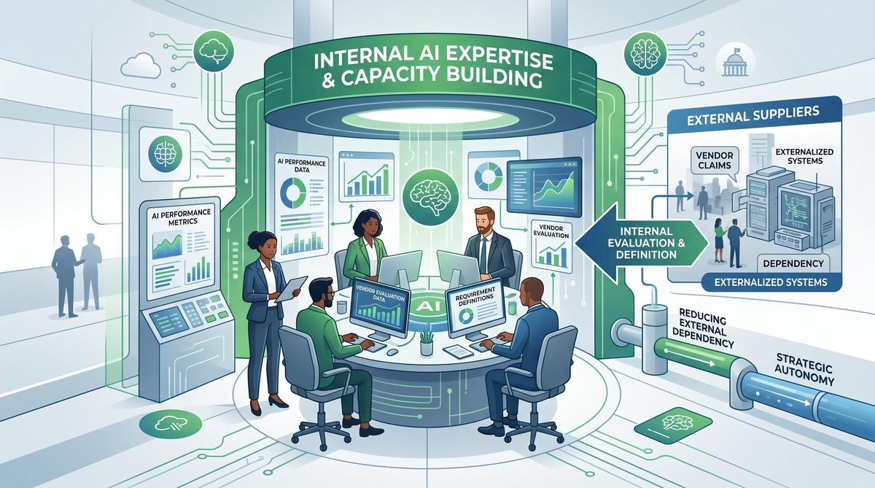
The most persistent barrier to effective government AI adoption is not technology or funding, it is human capital. Procurement departments can purchase cutting-edge platforms, consultants can deliver impressive demos, but sustainable AI capability requires deep institutional expertise that only exists when governments invest in building internal talent rather than perpetually outsourcing intelligence.
External dependency creates strategic vulnerability. When government agencies rely entirely on contractors and vendors for AI expertise, they lose the ability to critically evaluate recommendations, maintain systems independently, or adapt capabilities to evolving mission requirements. Each procurement cycle risks starting fresh, with institutional knowledge walking out the door alongside departing consultants. Building internal AI expertise breaks this expensive and dangerous cycle.
The talent challenge is genuine. Government compensation structures, hiring processes, and workplace cultures historically struggle to attract and retain technical specialists who command premium salaries in private markets. Senior data scientists and machine learning engineers often receive offers from technology firms that government salary bands cannot approach. Competing directly on compensation alone is a losing strategy for most public agencies.
Successful government AI talent strategies offer what private employers cannot. Mission impact attracts professionals who want their work to matter beyond quarterly earnings. Benefits allocation algorithms that keep families housed, environmental monitoring systems that protect public health, and educational tools that expand opportunity offer purpose that resonates with mission-driven technologists. Government employers who effectively communicate this impact advantage attract talent motivated by more than compensation.
Alternative compensation structures expand hiring flexibility. Specialized pay bands for technical positions, remote work arrangements that eliminate geographic constraints, student loan forgiveness programs, and accelerated career progression for technical tracks help bridge compensation gaps. Fellowship programs that bring technologists into government for defined terms build capability even when permanent retention proves challenging.
Upskilling existing personnel offers often-overlooked opportunities. Government workforces include thousands of professionals who understand agency missions, navigate institutional complexity, and maintain relationships with stakeholders. Adding AI literacy to this domain expertise creates hybrid capabilities more valuable than purely technical hires who lack institutional context. Training programs that develop data science skills among subject-matter experts multiply AI capacity rapidly.
Strategic consulting partnerships like https://rothaiconsulting.com demonstrate how specialized expertise can support capability building without creating permanent dependency, offering models for how government agencies can access external knowledge while developing internal competencies.
Organizational structure significantly affects AI talent retention. Agencies that isolate technical specialists in IT departments separate them from mission impact and career pathways. Embedding data scientists and ML engineers within program offices, where they collaborate directly with policy and operational colleagues, increases engagement and retention while improving outcomes through tighter integration between technical and domain expertise.
Professional development infrastructure sustains expertise over time. AI fields evolve rapidly; capabilities that represent cutting edge today become obsolete within years. Conference attendance, research participation, technical training budgets, and collaboration with academic institutions maintain currency among government AI professionals. Agencies that invest in continuous learning retain talent longer while ensuring capabilities remain current.
Communities of practice connect dispersed experts across organizational boundaries. Government AI professionals often work in isolation, unaware of colleagues facing similar challenges elsewhere. Cross-agency communities, professional associations, and knowledge-sharing platforms reduce duplication, accelerate learning, and create career networks that improve retention by expanding professional community.
Leadership literacy represents the final essential element. Senior officials who cannot distinguish between AI capabilities and vendor hype make poor strategic decisions, fund inappropriate projects, and set unrealistic expectations. Executive education programs that develop sufficient AI literacy for informed oversight enable leaders to champion AI initiatives effectively while holding them accountable for results.
Key Takeaways: - Sustainable government AI capability requires internal expertise rather than perpetual outsourcing to contractors - Mission impact, alternative compensation structures, and upskilling programs attract and retain AI talent despite salary limitations - Embedding technical specialists within program offices and investing in continuous professional development improves retention - Leadership AI literacy enables informed oversight and effective strategic decision-making about technology investments
Resources: - https://rothaiconsulting.com